I just got a new monitor, and it supports 98% of the P3 color space, a high gamut screen. I had a high gamut screen some 10 years ago. Just as 10 years ago, Windows is still unable to properly support this screen. The result is that on Windows, all colors are over saturated for everything.
Now, the monitor maker has some blame here. The associated profile seems to resolve in the sRGB color space, and Windows is applying that. But the problem is, there’s no easy or obvious way to simply select a better color profile (like a generic P3 color profile). And, even if I do go to the ancient, incomprehensible ICC screens (I’d bet $100 the developers who built that thing don’t even know how it works), it doesn’t actually apply to most apps! The app has to be aware of color management and tag the content appropriately. But even apps that are aware, like Photoshop, only tag the content you might be working on?—?so their own UIs are often over saturated. Even color aware apps on Windows aren’t properly color managed…
The problem is breathtakingly easy to describe, by simply describing the way it works on macOS. In macOS, I can simply choose a different color profile, including one that I produce myself with a color calibrator (Spyder or similar), and the result is that all the windows that aren’t color aware, are adjust to look not over saturated. It’s like magic! It’s also easy to describe why—macOS simply treats the unmanaged stuff as if it were sRGB, and adjusts it accordingly.
So why is this so hard for Windows to photocopy? All I want to do is apply a more appropriate color profile, and not have red icons stab me in the eye. It already works on macOS. So what’s the problem? Get out your photocopiers, Redmond, and make it work.
Maybe if this stuff worked right, we wouldn’t need “sRGB” mode, like this new monitor supports. What a crock?—?it should be called “Windows backwards compatible mode” because that’s what it is. Support for a hopeless platform. Maybe if this worked right, the associated profile could accurately reflect the capabilities of the monitor, instead of assuming broken, weak support in Windows, and using an insufficient sRGB profile.
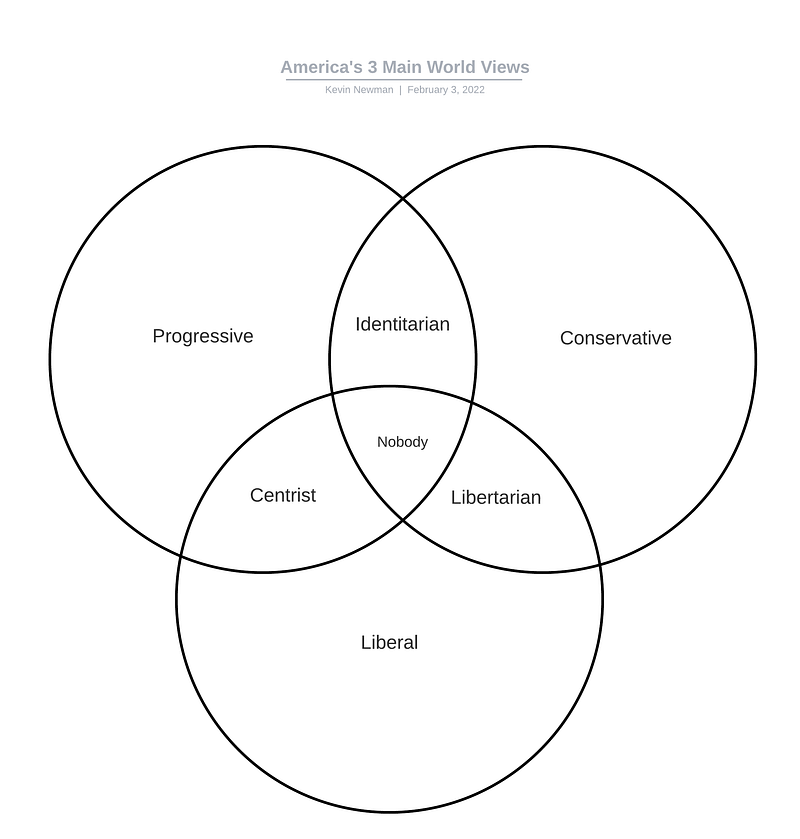
The concept of left/right in politics is debilitating in it’s lack of dimensions, but it’s useful to structure discourse. I thought I’d broaden things out to offer a less debilitating, and hopefully more accurate break down of American political world views. Things are still more complicated than this, but it’s based on the idea that there are actually 3 main world views in American politics, not just two. No one fits neatly in to just one world view, and no one is consistent on which they apply to all issues?—?most of us use one or another almost completely unconsciously, based on social context, and will apply different ones to different issues.
The main things I wanted to show with this are where the identitarian politics and “centrism” really fits, because left/right doesn’t cover it. Identitarian politics, how I loath thee. It is the politics of identity, of “othering”?—?whether it’s about the aggrieved minority (Democrats), or the aggrieved majority (“white” Republicans), it doesn’t matter?—?it’s all the aggrieved in-group vs the out-group oppressors, asserted by a static unchallengeable authority, and it’s always dangerous?—?yes, even when Democrats do it.
Terms like “liberal” and “centrist” have been so debased, that it’s hard to even discuss them. We live in a liberal culture, with a liberal democracy, and a liberal economy. We are almost all of us liberal, despite the way right-wing media uses that word as a slur against their favorite straw-man opponents. Whenever CPAC conservatives talk of “liberty” they are dipping in to liberal moral frames. “Centrists” are simply arrogant?—?they believe they sit in the void in the middle of this chart, but they are really just promoting a specific kind of economic classical liberalism mixed with a moderate amount of social support (progressive morality). Centrists have failed to noticed how much they’ve drifted to an extremist kind of liberalism (neoliberalism) away from support in any legitimate sense. Support is all just lip service from centrists, and that’s put progressives in sharp contrast. But we can work on that. Progressives have made their own mistakes, courting identitarian politics too aggressively, because they don’t have any natural aversion like liberals do, to leveraging authority.
Conservatives can’t stand centrists, because they don’t represent conservative values of self-discipline and their specific kind of authority. Conservatives are all about authority, not liberty, not that they seem to be any kind of self aware about it. When they are talking about liberty, it’s a specific kind of liberty, the kind where they get to set up their own little strict father fiefdoms. Ask a conservative (who’s not also a libertarian) if you should obey a police officer. See if you get an answer about liberty.
There is a funny alliance between “centrists” and identitarians, but we can see this starting to fray as the identitarians get ever more hard-line and inflexible about every little perceived slight, and lean harder and harder on conservative model authority (I’m right because my cause is righteous, and my authority to define terms shall not be challenged!). Identitarian politics is as illiberal as you can get.
These inflexible identitarians are going to cost progressives and centrists a lot in the next election (2022), count on it. Look at the chart, it’s a completely ridiculous alliance. When “centrists” blame progressives for those losses, they’re partially right, but only because of the identitarian component?—?and we can do something about it, if we understand our values, and stop the madness (or we can cancel Whoopi for the crime of having said something unpopular, but probably true…).
The key to understanding the blended positions is that they aren’t blended at all. The folks in those in between spaces hold multiple separate world views. There is no rational compatibility between liberalism and conservatism, or progressive and liberalism. That’s why the libertarians seem so bizarre, and centrists so wishy-washy. American libertarians are seen as something of an anomaly?—?but if you understand moral reasoning in the human brain, it’s easier to understand. Economic liberalism on the economy, so they can do strict father conservatism in their businesses and at home. That’s the exact opposite of progressive. It’s the same for identitarians and centrists. These multi-world-view in-betweens are more defined by what they oppose than what they support. Each of these in between groups will simply apply one of their world views to a different issues, or in a different social contexts. They aren’t blending anything. It’s more like balancing competing concerns. I almost labeled the “nobody” space “Zen.”
It’s the liberal in me who has a problem with identity politics. The progressive in me wants to address their grievances. This is not easy to balance, but imagine how much easier it would be to balance if we could talk about it directly without getting cancelled. There are multiple incompatible world views at play. None of the 3 main world views are wrong in their morals, even if they are doing some reprehensible things in the pursuit of puritanical versions of each. They are each righteous inside their own frameworks. Even conservatism has a place?—?but it’s dangerous on its own?—?all 3 are. They must be balanced.
BTW, rationalist thinks they are in the “nobody” place, but the truth is, they are mostly one of these groups, doubling down on a particular moral world view, and calling it more rational than the other rationalists. A real rationalist would be eager to learn how moral cognition works, and start to map this out, but they have mostly just doubled down on their own kind of identity based in-group mockery, and it has to stop. We need to figure out how to balance these things, so we can occupy that central space in a real way.
I call one who would occupy that place, the radical moderate. More on that to come.
I wrote a while back about how Facebook and Twitter have made a core mistake in their political algorithm which filters all content, and all users, into the debilitating concept of left and right, leading to media silos. In previous articles, I’ve written about the 3 commonworld views in America, and they aren’t even the only ones. Many others have written about how politics have become extremely partisan, and how much more consistent party identity aligns with believes about a given set of issues. All of this is due to the mistake of those sorting algorithms, which create silos on 2 extreme ends of a single dimension?—?party affiliation. And worse, party affiliation based on American notions of 2 party rule.
A simple way to fix it is to stop filtering people based on the broken idea of left/right. What a reductionist load of shit that entire idea is. If you are pursuing “engagement” so you can sell clicks, reads, or ads, then it makes sense to only show people what they want to see. It’s not even good for that. The simplest adjustment would be to gauge individual user interests, on individual issues, instead of filtering everything through an absolutely moronic left/right false dichotomy. Then you could have someone who’s media silo shows them content that doesn’t align cleanly with party identity. You might for example, get a pro-life reader, who is also anti-gun. That used to be a thing. It is increasingly less so, and the the reason for that isn’t a mystery. It’s the social media, and Medium publication sorting algorithm producing remarkably consistent messaging machines aligned along party silos. It’s the ultimate algorithm driven echo chamber, and hit has to stop.
A FAR better approach, at least for society and for mental health, would be to not even filter based on preferences, but filter based on something healthy. I suggest a measure of extremism, and inflexibility. Simply, don’t boost the extremist expressions, and don’t boost the hard-line expressions. It’s true, that would likely reduce the spread of Republican posts. That would be great, thanks. It would also halt a lot of what Republicans complain about from “the left” (which really just means Democrats , while “right” just means Republicans… life as understood by a 2 horse race…)
How do we stop this madness? In Medium, I clicked on one right wing-ish article, and now I’m inundated with right wing shit posts about “right” issues, and “leftists” and screeds against “woke” —ARGH. If this is what Medium is going to be, then I’m all the way out. How do we fix this?
We need to talk about whether “engagement” is the right metric for measuring all of this. But if we are going to measure and optimize for it, at least we can stop with the brain damage inducing left/right filtering. It’s literally destroying the world.
The right wing has a strategy to change American culture to adopt their abhorrent, often self conflicted, “strict father” moral world view. That strategy is well formed with a clear goal, and a specific method to achieve that goal. It’s based on science, to control the cultural narrative. Progressives don’t understand what this strategy is based on, how it works, or why we keep losing every battle. We let the right wing define the terms of every conflict, react to that, and then lose. It doesn’t have to be this way. We can lead again?—?but we have to understand the rules of engagement, and exactly what the right wing is doing. It’s not that complicated, but it involves understanding world views, and that’s especially hard when the new information conflicts with your own world view.
Progressives have a moral world view based primarily on empathy and support. George Lakoff calls it “progressive family morality.” We have an authority model based on open inquiry and accountability. Conservatives don’t have any of this. Their moral world view, “strict father morality” is different. It’s based on discipline through punishment, and an authority model based on a mix of in-group seniority and gender, and often (but not always) other characteristics like religion and race, and that authority cannot be challenged, except on the basis of discipline or lack thereof. That last bit is important?—?it’s not important to them that their precepts are correct, only that they remain unchallenged. Now think about how progressive authority works?—?you might already see some conflict.
A moral world view is the basis for all political views?—?the starting point, the premise of every political arguments is a moral truth defined by your world view, and a moral cannot be challenged or proven rationally. What is right (righteous) just is. This is the hardest part of all this for rational “centrists” and progressives to accept. We want to help immigrants because it is righteous to support and care for people who need help, according to our moral world view. Conservatives want to punish them for a perceived slight (crossing the border without paperwork, or really, for just being part of an “other” out-group). That’s the starting point.
The thing with progressives and liberals is we are rationalists, and that partly makes up our world view. We tend to think we can logically arrive at the proper set of morals after reason, but that’s demonstrably not how it works. It’s a jagged pill to swallow for rationalists, but it’s simple and it’s true. All politics, and all political issues are filtered through our moral world view. The rest are arguments meant to justify the moral judgement. Progressives rationalize away the drug traffickers among the illegal immigrants as refugees. Conservatives rationalize away the refugees as drug traffickers. The facts don’t matter here?—?the judgment is decided earlier than the argument, by your moral world view. The truth about immigrants is a mix of these facts.
So, how do we win, or at least make sure our preferences are considered on an issue like immigration? We understand why we want what we want, and we just explain that. Yes, there is a mix of bad actors in a mostly victimized group of people that we want to help in undocumented immigrants. The morals say, how we treat them is not only about them. It’s also about what it says about us. Americans help people. America’s culture IS nurturing. They need help, so we help them. And we are good, strong, and capability people who have the capacity to help them. Scarcity is a nonsensical conservative idea. How we treat people in need says everything about us. It says everything about us, to us, but also to the rest of the world. Conservatives can take their “all the world is a nail” punishment and stuff it. We are helping these people, because it’s the right thing to do. (The facts are on our side?—?feel free to explain that, but only after making the moral argument to frame the facts.)
Which argument do you think will win? We should live up to our morals, or we should punch down on desperate people? If we talk about these issues morally, we’d make progress— but we can’t just react to focus group tested, right wing talking points?—?we can’t call them “illegal immigrants”. Their legal status is not the most important aspect. Our need to live up to our higher morals is.
You might have noticed how easy it is in the previous section to conjure conservative values labels, and how comparatively weak the progressive labels feel. This is not an accident. Conservatives have been promoting their moral world view, systemically and successfully, for decades, while progressives and liberals have not. They have use focus groups and polling to both push and test for specific short phrases they can use to activate the compatible moral world view on their chosen issues. The result is that they are absolutely dominating the contest to change American character. Idiotic conservative drivel like DILLIGAF (do I look like I give a f***) is now dominating American culture. yes, I do give a f***. And you know what? Most American do too.
But why is this effective? It’s because we all have multiple world views in our brains at the same time, and we make decisions based on which one is active at the moment of a moral question, and we do it almost completely unaware?—?unconsciously. And, they are activated by simply saying words?—?even when you then argue against them. If I say, “Don’t Think of an Elephant,” you can’t do it. That’s the science, and it’s another jagged pill for rationalists. It used to be that Americans exercised progressive morality in some contexts, like maybe a labor union meeting, or school, and exercised conservative values in other contexts?—?the home, or at work. It used to be that we saw those morals expressed in art and movies and writing, based on that experience, and the intuition that comes from experience. But its getting harder to find it in pop culture any more. All those “grounded” and “dark” TV shows? Yeah, they are pushing a particularly nasty conservative world view. Everything is conservative, action movie morality.
Most people, even if they feel conservative values aren’t quite right for a given issue, seem unable to really explain an alternative. They certainly can’t explain issues in language other than conservative frames they’ve been given. They fall repeatedly, and frustratingly, into conservative framing traps, and don’t seem particularly aware of how it works. That makes sense. Conservatives and Republicans have entire institutions whose job is exclusively to propagate their moral world view. Progressives have exactly 0 matching institutions?—?all progressive institutions are tied to specific issues or electoral outcomes. As a result, everyone has an easy time explaining conservative morals, and applying them to policy?—?including the media?—?but cannot even begin to describe the better, more American morals beneath progressive policy.
It’s no wonder the media can’t make any sense of the words Nancy Pelosi speaks and keep asking for her “message.” They say “message”, but really, they are asking for her moral world view, or for a brand message, and she’s been unable or unwilling to articulate one. In a recent presser, after getting frustrated, she does get half-way there?—?she says the word responsibility repeatedly?—?but responsibility is defined differently by the two moral world views. To progressives, responsibility is to nurture and support. To conservatives, responsibility is more like obedience to their moral authority. It’s not enough to just say “we have responsibility”?—?responsibility to what moral truth? It’s not enough to say some policy is better than some other?—?better at achieving what moral outcome? Nancy Pelosi’s responsibility is defined by liberal notions of individual responsiblity, and progressive notions of compassion, nurture, and support. But she never said these words, and the reporters, were left scratching their heads. (Honestly, Nancy Pelosi shouldn’t have to explain her world view, journalists should know about this stuff, but that’s another issue.)
All of that is just context, and it doesn’t really show how to apply this in specific issues. So here are some quick and dirty examples of how to apply all to political messaging. Again, you’ll notice how much more work I have to do to set the moral frame than a conservative counter point. It’s not because it’s more complex?—?we just don’t have the decades of consistent tactics to build the labels.
We empathize with those stricken with sickness and understand it can happen to anyone, at any time, without reason or discrimination. We must care for and protect each other in tough times, especially (but not limited to) those tough times over which we have no control, so we will provide health insurance to all. Conservatives want to punish the sick, because they see them as deserving their sickness?—?they must have done something wrong, or failed to prepare, or had no discipline, or some other twisted logic. Conservatives are not greedy on the issue of healthcare— it’s not about money. In fact, they are willing to spend more to punish the unworthy?—?and we do. They want to punish the sick, and they are willing to pay for it.
We see CEOs who take home billions while paying their workers less than they can live on, as disloyal wage thieves, exploiting those who do the real work to build their companies. We see billionaire freeloaders who take and take, and don’t give back, no reciprocation. They can call their ill-gotten gains “earnings” all they want, we see right through that. Conservatives see folks like Jeff Bezos or Donald Trump not as exploiters, or obvious con men, but as disciplined strict authorities, and therefor deserving of the riches they greedily stuff in their own pockets. Greed is good to conservatives. To progressives, it’s obviously theft and unbalanced moral equation.
Progressives want to take care of veterans, folks to whom we owe a moral debt for their service, and their sacrifice, especially those who have been injured in any way. Progressive nurture and support?—?even veterans. Conservatives want to let them suffer, because they weren’t disciplined enough, not ruthless enough, to take care of themselves after they are no longer of use in the military, or some other twisted logic. Veterans are not enough like Donald Trump to conservatives, not disciplined enough to deserve dignity after service. Trump once said, “Americans who died in ware are ‘losers’ and ‘suckers’”. To a strict father world view, that makes total sense?—?it’s all about discipline, empathy is not relevant. Every conservative, and every Republican ate that right up. Donald Trump is a very disciplined brand marketer. Extremely disciplined. It’s the entire reason conservatives love him. They don’t need anything more. It has made him the perfect strict father for conservatives. Not vets, who have sacrificed for us, and who deserve our respect for their service. Every voter who would side with Donald Trump, or any other Republican, after saying something like that has betrayed us all, but most especially veterans.
I could go on?—?but you can see how knowing our morals, and those of our opposition can help explain the truth about why we believe these things are righteous. It’s not enough to explain the mechanics of how a policy works. It’s great that Democrats wan to provide day care to all workers. But why? What’s the moral underpinning of that? It’s to nurture and support. If it’s about discipline, then parents shouldn’t have had children until they were financially ready (we’d have almost no new babies if we did that…) We have to communicate the moral intent?—?and we have to do that FIRST?—?then we can explain the details of how it achieves that moral end until midnight.
Once we internalize this, and use it to frame our arguments, we’ll start to win, and I believe there are a LOT more of us than the hateful conservatives. Until we do it, we’ll continue to get our butts kicked, decade after decade. Our morals are better, but we have to state them, at the beginning of every argument, repeatedly, every time?—?until we are sick of it, then repeat it some more. If we keep trying to sell policy through rationalism, without communicating the moral foundation on which those policies are built, we’ll keep losing every battle. We can already see where that leads.
We can’t challenge the ascendancy of the right wing if we don’t understand them?—?and they are not that hard to understand. We also can’t beat them if we don’t understand ourselves. We aren’t much more complicated, but what we do is harder to pull off, yet produces greater rewards than the often self-defeating right wing “strict father” ideology will even allow itself to dream of. Our morals are better. Let’s fight for them.
The problem with the issue of climate change (other than calling it “climate change”…) is that for most of the folks who are trying to get something done, they’ve adopted a needless barrier that we get universal buy in to solve it. That preference for solidarity based policy alone has done more harm to the mitigation strategy than any other aspect of this issue.
What am I talking about? Well, there are multiple kinds of policies (I’m ripping this directly from Matthew Taylor’s RSA presentation on “The Power to Act”).
1. Solidaristic – we all agree to turn off the lights when we leave a room, and recycle our plastics.
2. Hierarchical (authority) – we ban the use of fossil fuels, or mandate catalytic converters, etc.
3. Market bases – we’ll compete to create better products, which reduce the reliance on the old ones, etc.
The environmental movement mostly focuses on #1 (probably arguing they need that to get #2, which is in absolute terms, bunk).
But really, I agree with Matthew Taylor, if we want to make any real progress, we need to properly balance all 3 (I’d actually argue, you only need to balance #2 and #3, and that #1 is a consequence of that balance, with Taylor’s 4th type – despair – being a consequence of failing to do that – the 4th one, sound familiar?)
What would that look like? Well, how about if instead of trying to use that old conservative punishment model, where we restrict what people want to do (burn coal), we instead provide incentives to produce the competing technologies more rapidly. There are 6 renewable sources of energy, and only 4 dirty sources. We already know the clean ones will be more efficient than the dirty sources, it’s just a matter of time. So lets accelerate that.
I know, I know, the “experts” say that it won’t be enough – well, the experts thought we couldn’t replace ozone depleting freon with anything else in refrigerators, and it took one congressmen, and a small cash reward, like a year to get 3 alternatives back in the 80s. So forgive my skepticism. (Honestly, I wish I could find a source for this – I heard it on the radio ages ago. Still, there are other examples of making the new thing cheaper, rather than making the old thing more expensive, and this is the clear direction we should be going.)
And yea, it’s true that we need to be a lot more about carbon capture/sinking. So let’s fund some efforts to do that using hierarchy. Let’s stop waiting for global buy in – what a waste of time. Let’s just start putting the money and market activity using authority to fix this. We don’t need buy in, we just need some smart people to do the work. Most of the smart people who could do this work, just want to pay their mortgage while they do it. It’s not even expensive.
Oh! That’s already happening. Even without scaring the next generation to death (seriously, they are petrified – that’s not helping), many countries are now (finally) starting to do exactly this.
Now let’s get Australia to remove their ineffective shark nets. Gawd those are dumb.