unFocus Projects

Author: Kevin Newman

  • Progressives suck at political morality


    Progressives suck at political morality

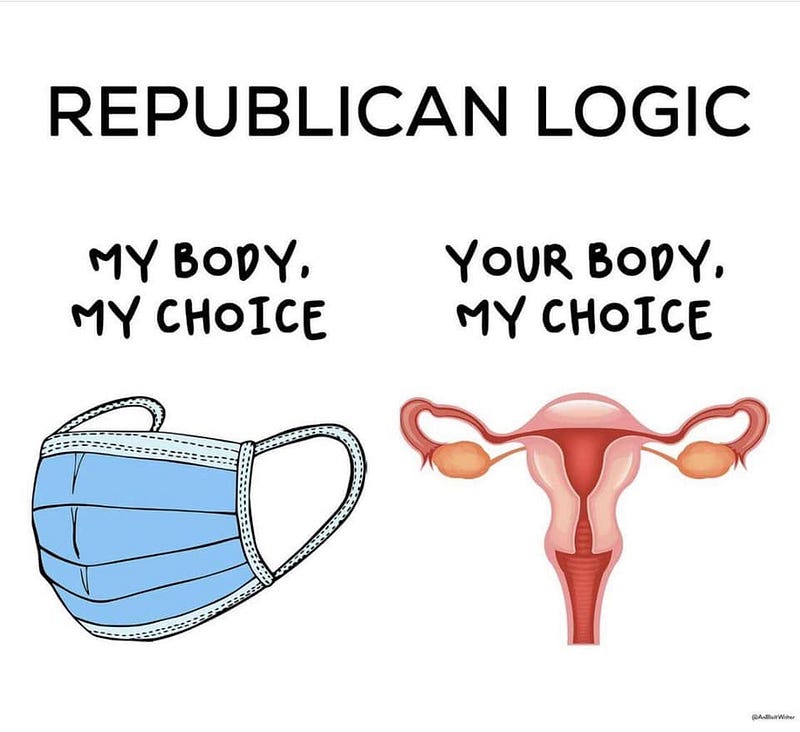
    A conservative Republican would look at this meme, and see no contradiction.

    There’s no logic in political arguments?—?it’s all moral, and more specifically, based on a moral world view, which is a metaphor built on a specific kind of family dynamic. Political world views are the family metaphor, extended to the broader nation. For conservatives, its the strict father dynamic, for progressives, it’s the supportive family dynamic. All political statements are built on one of these family metaphors.

    The meme in question depicts a mask with the label, “My Body, My Choice” and a uterus with the label “Your body, your choice”. It’s a left leaning, meme, meant to highlight an apparent obvious contradiction in conservative logic, and to those who already agree with the pro-choice premise on the issue of abortion, they’ll get it instantly, and share it, and laugh at conservatives, and maybe even hope that they’ll convince someone that they’re being contradictory. The problem is, a conservative would perceive no such contradiction. They’d interpret the same information as presented as having no contradiction at all, and if you don’t understand why, then you just don’t understand politics.

    In strict father morality, the “strict father” makes the decisions for the family unit, and his authority should not be challenged. That’s the core moral at play in this meme, and both these anti-mask and anti-abortion arguments fit right in to that?—?there is no contradiction. The strict father role is to protect their family. They are supposed to decide how to do that, through their own hard-earned discipline. They alone must decide whether to employ masks to protect their families, and they alone decide how to handle reproduction for the family, especially where risk is involved, for both the mother and the unborn baby. We can’t logic our way out of any of this. That’s how their entire moral world view is built. There is no contradiction in this meme from their perspective.

    Progressive morality is very different. It’s built on a model of support, empathy and nurture. It says we must build our families up through support and nurture, so they are prepared to take on the world. It says that we should defer to the validated authority, because the supportive family’s authority is not just “Dad,” it’s whoever within the family unit has demonstrated command of the facts on any given issue through open inquiry. Every progressive family works this way?—?extended to national politics, that means we build support structures, and defer to experts. For the masks issue, the validated authorities?—?medial experts?—?say they work, so we wear one. Simple. Progressive morality, by the way, lines up with what we’ve come to learn about how human nature really works through science. It’s better, frankly.

    Abortion is harder?—?and frankly, the “pro-choice” folks on the reactive left frame that one all wrong. It’s not only about choice, it’s about support, and especially support and empathy for women who find themselves in a situation that is challenging, both socially and personally. If we constrain the moral frame to just our “validated authority” morality, then abortion is about woman’s personal choice, because they are the validated authority of their own bodies, but it’s not only about that. We are truncating the moral argument by over emphasizing choice. There’s a whole set of moral tools we are leaving on the table on this one.

    But progressives and liberals have largely not learned how any of this modern moral argument works, so they are mostly reactive?—?the right wing frames the left’s positions, and it’s almost always a trap. For example, “gun control” is an absolutely terrible metaphor, that puts government in “control” of an entire issue, and is about an illiberal as you can get, from a policy standpoint. It’s about “gun accountability”?—?conservatives literally never talk about accountability, because that’s external, it subverts the role of the disciplined “strict father”. But that doesn’t mean we should shy away from making the argument?—?in fact, it’s important.

    There are biconceptuals, those who hold both incompatible moral world views at the same time (no, they aren’t crazy, but they are unaware, mostly). The way to get them on our side is, exclusively, to make arguments that are framed within our better moral world view. We must tap in to progressive supportive family metaphors, to strengthen those pathways in the brains of biconceptuals. But we don’t, and it’s why we constantly lose ground. If we know our values, it’s much easier to make moral arguments. This is important?—?we are losing the war, even though we have the plainly better family dynamic.

    In the supportive family dynamic, parents have equal and equivalent responsibilities, to support and guide our families (and the public by extension) to supportive policies?—?like public education, and social safety nets, and minimum wage laws, child labor laws, etc. It’s not just better to make the moral argument?—?it’s necessary to make any progress. But the arguments in this meme don’t do that?—?we can’t logic our way to victory. That tactic been failing for decades. Political thought is not logical or rational. Reason doesn’t work to convince anyone of anything in politics. All politics is moral.

    (What is he talking about? If you are interested in hearing from a real scientist on the topic, here is the best intro to moral politics from George Lakoff I can find.)

  • Vote suppression is the only “election fraud.”?—?a lesson in “values framing” for Democrats


    Vote suppression is the only “election fraud.”?—?a lesson in “values framing” for Democrats

    “They hate fair elections. This is about Republicans subverting democracy for those who vote against them. Vote suppression is the only ‘election fraud happening here.’ We know better.”

    If I say, “Don’t Think of an Elephant,” what did you just picture in your mind? It works the same for any moral political statement?—?and all politics is moral. My statement frames our side in “fair elections” and their side in “subverting the vote” through “vote suppression”. Even uttering their poll tested phrase, “election fraud” is risky, and probably unnecessary, but I left it in for illustration. It MUST come after the rest, if it has to be used.

    I found a typical post from a Democrat answering Republican a talking point by using that same talking point to “frame” their statement, falling right in to the same damned trap Democrats have been falling for for decades.

    Here’s the original, “This isn’t about election fraud, it’s about republicans obstructing the vote from those who may vote against them. We need to call it what it is, an attack on our democracy and fair elections.”

    The trick I used to rewrite this is simple. All I really did here is reverse it and add a few more values statements. The conclusion is first, so that MY values (and yours) “frame” the topic, instead of letting THEIR poll tested trigger phrase frame the topic. I did the same with the overall structure of this post.

    Come on Democrats, our values are better than theirs. This might seem like a little thing, but the knowledge of how this works is the only advantage Republicans have. They’ve been killing us?—?often literally?—?by simply using a technique we refuse to learn.

    What is the hangup?

  • Facebook is the Last Mile of Media Publishing, and Should Act Like it


    Facebook is the Last Mile of Media Publishing, and Should Act Like it

    Mark Zuckerberg is a smart guy, and from most accounts, tries to do the right thing with his influential platform. Given the newness of social media, it must be challenging to figure out what that right thing is?—?especially when billions of dollars and the demands of share holders is on the line.

    Recently Mr. Zuckerberg was quoted saying that he doesn’t think its Facebook’s job to fact check political speeches. I think he’s probably right, but only in one specific way. Facebook is not in the news media production business?—?they don’t write the news. But they are an intermediary (the root of the word “media”) just he same. Conceptually, they are at least as influential as any publisher, in choosing which content to show users. Practically, given current trends, they are more influential than any news outlet’s front page?—?or all of them combined. I’ve written previously about an important (easy to fix) mistake in their curation algorithm which leads to two information silos modeled largely on a reductionist idea of America’s 2 parties— left vs. right, Democratic Party vs. Republican Party. That’s one half of the problem, and they should address it. But they also have some responsibility to promote fact based reporting, and thwart misinformation, just like any other media publisher. They don’t write content, but they certainly do promote it, selectively, to each and every user.

    Fact based news coverage is not sexy, but is essential for functioning democracy, and it requires credible, authoritative, expert validation. By many accounts, people “like” negative, bias confirming, often factually inaccurate posts more often than they “like” positive, moderate and factual posts. This is not a problem created by social media. Over the last 40 years fact reporting and investigative journalism has declined, as bombastic opinion writing and increasingly partisan infotainment and editorial has taken up the slack, in an attempt to capture both political influence and profit. It turns out, people are more motivated by in-group dynamics than reason, and catering to that is more profitable than not?—?for all media. It’s in this context that social media has the power to either enhance, or blunt the power of misinformation. Facebook’s current curation model, and decision to keep driving forward, enhances the problem, rather than curtailing it. Doing nothing is not doing nothing in Facebook’s case.

    Facebook, whether Mr. Zuckerberg likes it or not, has embedded itself in the last mile of the publishing pipeline for much of the news media citizens consume. Facebook should do the work to balance their own profit needs, vs. the impact they have on their users’ perception of the facts. Social media is media.

  • FaceBook’s Political Algorithm Error and Tribal Extremism


    Facebook’s Political Algorithm and Extremism Silos

    The social media echo chamber problem is strengthened by a simple algorithm mistake which Facebook and seemingly all of the social media platforms have baked into their cores. The Wall Street Journal recently shed light on part of the problem —Facebook chases “engagement,” by feeding folks more and more “sticky” extreme and enraging content, to keep them glued to the Facebook platform?—?and Facebook’s ads longer. Facebook categorically can’t fix this problem, because it’s at the core of their entire business model?—?which is likely why they chose to do nothing.

    But there is a second side of the problem, and I’d argue a more important part— the “silo” problem. Facebook (and other social media) ranks every post on a political spectrum from left to right on a 5 step scale. They rank each user that way too. You can see how they rank you in your profile’s “Ad Preferences,” if you’re curious. They use these values to feed us posts that fall within those parameters. Before social media, polls showed folks were often had strong opinions on single issues. Often they held points of view that didn’t align completely with a party. One might be anti-abortion, yet also anti-gun for example (even if only one or the other motivated them to the polls?—?so-called single issue voters).

    That happens less and less now, and I believe social media plays a role in this siloing effect, because these platforms are essentially sorting issue propaganda in two consistent “silos” on a simple 5 step spectrum. This drives partisan polarization on groups of issues together, rather than on single issues. Where we used to have a set of different single issue groups, that parties sort of gather in to a single coalition, now there are two large groups of people, who all think and understand an entire set of issues the same way?—?often with their own whole vocabulary to describe their set.

    Together with the propensity to promote partisan extremism on social media platforms, we have a dangerous mix. This is society breaking, and is rife for foreign and domestic actors to manipulate and exploit. Perhaps unlike the business model of promoting extremism, Facebook, Twitter, and the others CAN address THIS issue , they just have to be less lazy about how they categorize users and content. It’s simple, instead of following the largely illusory distinction between “left” and “right,” for everything (effectively building the previously fake distinction), rank content and users on a scale for each individual issue.

    The overly simplistic political curation mistake at the heart of Facebook and other social media platforms, is driving us to two increasingly extreme partisan camps. Fixing it is relatively easy, and could help steer us back to moderate sanity, even if it would not address the extremism problem. However, maybe if users aren’t constantly propagandized in echo chamber silos, it’ll be easier to find alternatives to promoting more and more extreme, enraging content to keep users engaged. Or maybe a turn to a different business model is called for. I’d be happy to opt-out of highly targeted political propaganda for $12 a year. More importantly, I’d happily pay again to opt my grandparents out…

  • Trump won on a feeling of powerlessness


    Trump won on a feeling of powerlessness

    The professional left through the DNC delivered us an impressive defeat, snatching victory from the jaws of defeat by installing unpopular insider Hillary Clinton at the top of the ticket, instead of allowing record breaking independent Bernie Sanders to take the nomination and helping him sale to victory. The result; losing the presidency, the House of Representatives, the Senate, and so much more at state and local levels.

    This robust thumping should give the professional left and DNC insiders a chance to finally understand what they have refused to see about working people. People feel powerless. It’s that simple. Racism, misogyny and white privilege are embedded in Donald Trump’s hateful campaign, but they are not the primary motivation for most Trump supporters. Working citizens are having a hard time. They feel little power to shape their situation and their futures, or to protect their children and their communities from all sorts of threats, including the whims of big business and their own employers. They see (correctly) business in cahoots with big and local government. Maybe some of them are doing just fine in quantifiable terms, but whatever wealth can be attributed to them provides little agency. The power gap driven by historic wealth gap is simply too large. The professional class within the ranks of Liberal Democrats seem to delight ignoring this problem completely, or even apologizing for it (looking at you Paul Krugman). Donald Trump addressed this powerlessness directly in his campaign, and it’s not surprising it found resonance.

    The professional left and the DNC have turned a blind eye to ongoing disempowerment, to their own peril. Nothing about the way they handled Sanders in the primary can be spun positively in light of this. But there’s a real chance for progressive Democrats to finally get the party on the right foot. Let’s talk about empowerment for working people. It doesn’t have to be unions?—?my favorite prescription is worker owned employers, an idea that sounds even bipartisan, evoking a great ownership society. The left already has a lock on compassion, but we need a positive vision to replace losing neoliberal and meritocratic idiocy. Losing has consequences, and the consequence of this loss is Donald Trump’s special brand of ignorance, regression and counterproductive GOP policy which will only make things worse for the very people who supported him?—?working people.